From Manual to Fully Automatic: How Counting, AI, and Robotics Work Together to Build a Smarter Plant
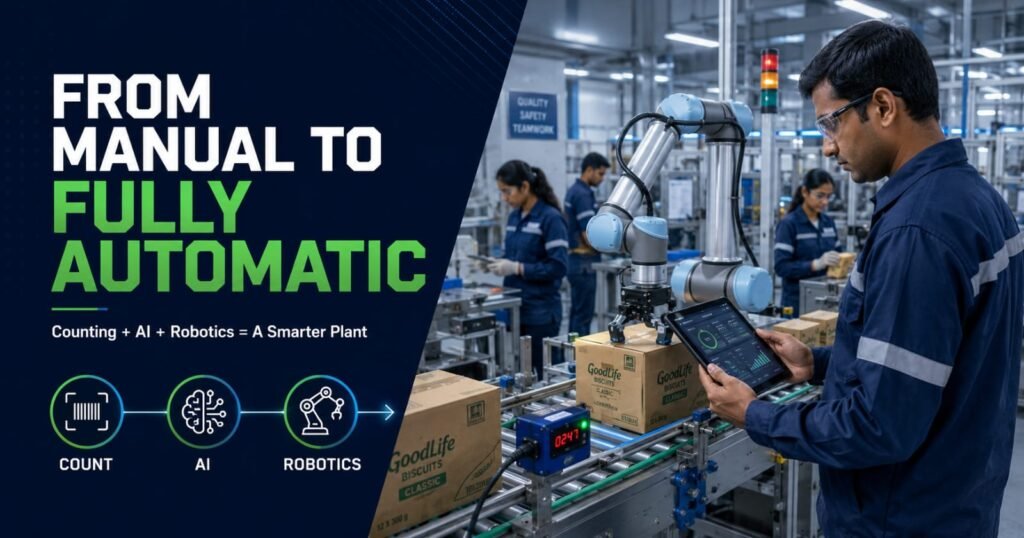
Discover how manufacturers can combine real-time production counting, ERP data, AI, and robotics to build smarter, more efficient, measurable, and automated plants.
Ask a plant manager how many units were produced yesterday, and the answer is often an estimate: “Around 4,800” or “Roughly 5,000.”
The reason is rarely a lack of attention. The number may simply come from a supervisor’s tally sheet, calculated manually at the end of a long shift.
But that estimate influences everything that follows—procurement, production planning, customer commitments, inventory, and management decisions.
And that leads to a simple truth:
You cannot improve what you cannot accurately measure.
For manufacturers looking to move from manual operations toward smarter, more automated plants, the journey does not necessarily begin with robots.
It begins with accurate data.
Step One: Start by Counting What Is Actually Happening
Before introducing AI or robotics, one of the most valuable improvements can be surprisingly simple: knowing the exact production output in real time.
Sensors and machine integrations can capture actual production directly from the line and feed that information into an ERP system.
Instead of waiting for a shift-end tally, management can see what is actually being produced.
Once the numbers become accurate, everything built around those numbers becomes more reliable—from raw material planning and procurement to production targets and customer commitments.
Step Two: Understand the Flow of Production
Once real-time data starts flowing, patterns that were previously invisible begin to emerge.
Which hour of the shift experiences the most slowdown?
Which production line consistently performs better?
Where does a process lose time?
Is the bottleneck actually the operator—or is a machine upstream running below capacity?
This kind of data should not be used simply to monitor workers.
Used responsibly and transparently, it can do the opposite: provide a fairer understanding of production challenges and prevent employees from being blamed for problems caused by machinery, material shortages, or upstream delays.
It can also create a more objective foundation for improving processes and designing fair incentive systems.
Step Three: Let AI Learn the Plant
Once a plant has reliable historical data, AI can begin identifying patterns within the operation.
The most useful AI is not necessarily generic. A model trained around a plant’s own machines, shifts, production history, and defect patterns can provide insights that are far more relevant to that specific operation.
It can help identify:
Quality issues before they become large-scale waste.
Instead of discovering a problem after an entire batch has been affected, early patterns can signal that quality is beginning to deteriorate.
Future raw material requirements.
Consumption trends can help forecast material requirements more accurately than relying solely on previous month’s estimates.
Potential equipment failures.
Machine data can reveal patterns that suggest maintenance may be required before an unexpected breakdown stops production.
At this stage, data stops being something management simply reviews.
It starts becoming something the plant can learn from.
Step Four: Introduce Robotics Where It Makes Business Sense
Automation does not mean replacing every human task with a machine.
Robotics is particularly valuable where work is highly repetitive, physically demanding, or prone to fatigue-related errors—such as lifting, sorting, packing, and palletizing.
But moving directly from a manual plant to a fully automated facility can require enormous investment.
A more practical approach is gradual.
Stage One: Manual, but measured
Production is still largely manual, but counting, tracking, and ERP integration provide accurate operational data.
Stage Two: Semi-automatic
Robotics takes over selected repetitive processes while people continue to handle quality decisions, supervision, problem-solving, and exceptions.
Stage Three: Fully automatic
Automation is expanded to processes where production volume, consistency, and data demonstrate that the investment makes commercial sense.
This approach allows manufacturers to automate with evidence rather than assumption.
The Smarter Plant Runs on Data
The journey from manual manufacturing to automation is not one giant technological leap.
It is a sequence of improvements.
Accurate counting creates reliable data.
Reliable data reveals production patterns.
Production patterns give AI something meaningful to learn.
AI identifies opportunities for improvement.
And those insights show exactly where robotics can create the greatest return.
The result is a plant that gradually moves from manual processes to semi-automation and, where justified, full automation—without making technology an expensive experiment.
The objective is not to build a factory filled with machines simply because automation sounds impressive.
The objective is to build a plant that is measurable, predictable, efficient, and intelligent.
Because the future of manufacturing may not be about choosing between people and machines.
It may be about creating an environment where both work better together.
માણસ અને મશીન સાથે મળીને આગળ વધે.
Man and machine move forward together.
— Covixy