Youngest Indian Male at 27 to Address UN General Assembly: Soumyabrata Sengupta Takes Up Environment, Women’s Safety and Sustainable Growth
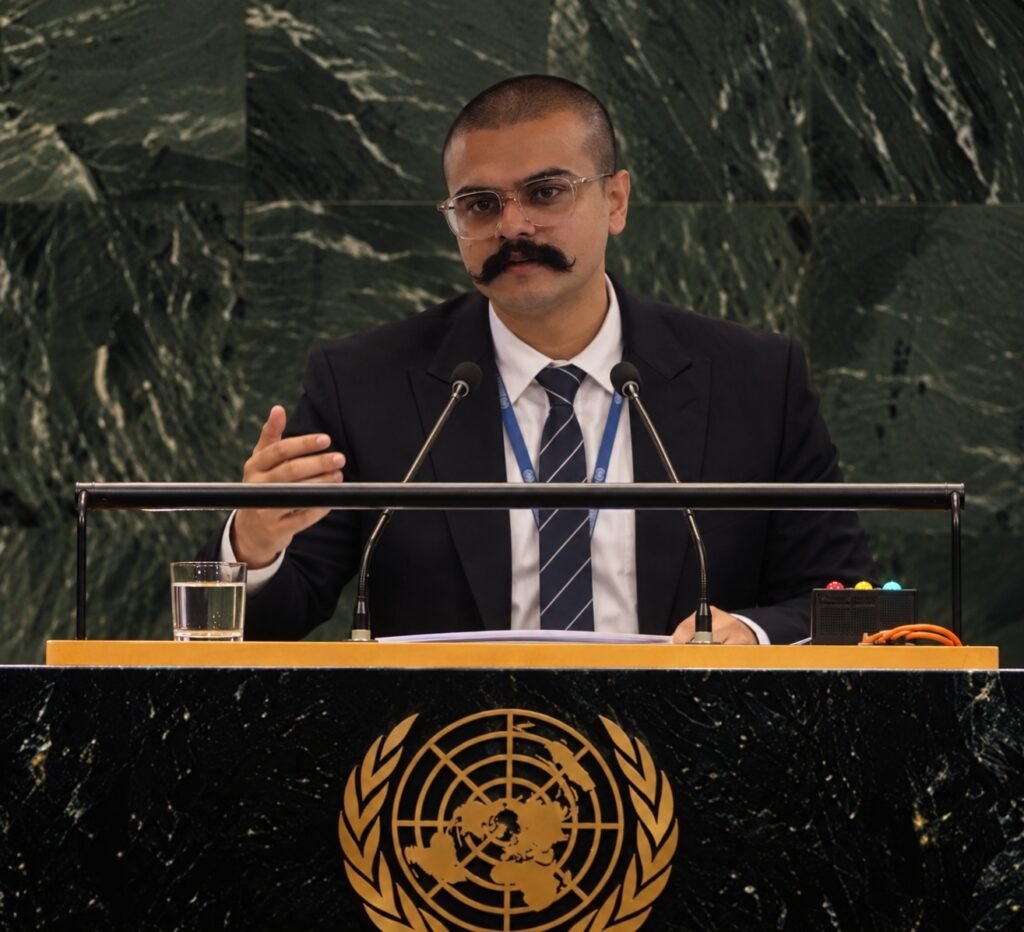
Soumyabrata Sengupta Takes Up Environment, Women’s Safety and Sustainable Growth
At 27, Soumyabrata Sengupta has addressed the United Nations General Assembly, speaking on three subjects that are difficult to separate from the larger question of what kind of society India and the world hope to build: environmental protection, women’s safety and sustainable growth.
Sengupta’s appearance at the UN comes at a relatively young age and has been described as making him the youngest Indian male to address the General Assembly and the second Bengali to do so.
What stood out in his address was the attempt to connect issues that are often discussed separately. Environmental sustainability, he argued, cannot be divorced from economic development. Economic growth, in turn, cannot be regarded as sustainable if large sections of society remain unsafe or excluded from its benefits.
Women’s safety formed an important part of his remarks. Sengupta spoke of safety not merely as a matter of policing or criminal justice, but as a condition for equal participation in education, employment, public life and the economy.
The argument was straightforward. A society cannot describe itself as genuinely prosperous while half its population continues to negotiate questions of safety and freedom in everyday life.
His comments on sustainable growth similarly sought to move the discussion beyond the familiar tension between development and environmental protection. The challenge, as Sengupta presented it, is not to choose between growth and the environment but to determine how economic progress can be pursued without transferring its costs to future generations.
For a 27-year-old Indian public affairs professional to be making these arguments at the UN is significant in itself. But Sengupta’s career has not followed a conventional academic or political trajectory.
He has previously served as a Media Advisor to the Government of India and currently serves as an Advisor to the Government of West Bengal with Cabinet Rank. He also serves as State Vice President for Digital Narratives of the Bharatiya Janata Party in West Bengal, where his responsibilities include digital communication and narrative strategy.
That political association inevitably places Sengupta within a particular political environment. Yet his UN address was not framed as a partisan intervention. The subjects he chose, environmental sustainability, women’s safety and sustainable development, are issues that extend well beyond party boundaries.
This distinction appears important to Sengupta himself.
“India is a democracy in which people will inevitably disagree about politics, economics and public policy,” he said. “But there are aspirations that are larger than those disagreements. People want to live in a society that is safe, prosperous, environmentally responsible and capable of creating opportunities for the next generation.”
That is perhaps the more interesting aspect of Sengupta’s appearance at the General Assembly. It was not an attempt to present India through a single political lens. Instead, the emphasis was on questions that have acquired a distinctly global character while retaining an Indian context.
His remarks on women’s safety, for instance, placed the issue within the broader framework of development. His environmental argument similarly sought to reconcile economic aspiration with intergenerational responsibility.
“Development cannot be measured only by the size of an economy,” Sengupta said. “It must also be measured by the quality of life we create, the environment we leave behind and the dignity and safety we guarantee to every individual.”
Sengupta’s public career has increasingly brought together areas that are normally treated as separate: strategic communications, public affairs, writing, research and international affairs. His work has included government advisory responsibilities as well as political communications, while his writing and research have dealt with contemporary questions surrounding media, society and public life.
The UN appearance therefore represents less a departure from that trajectory than an international extension of it.
At 27, Sengupta is still at an age when many professionals are establishing their careers. His appearance before the General Assembly places him in a rather different category of public engagement, one in which the opportunity to speak internationally is accompanied by the responsibility of being scrutinised at home.
That scrutiny is unlikely to be confined to the politics of the moment. Nor should it be.
An international platform does not make an argument correct merely because it is delivered there. What it does provide is an opportunity to put Indian concerns into a wider conversation and to test those arguments before an audience that extends beyond domestic political divisions.
Sengupta appeared to recognise that distinction.
“To speak about India before an international audience is an honour,” he said. “But it is also a responsibility. The objective should not be to speak the loudest. It should be to contribute something thoughtful, constructive and worthy of being heard.”
For someone only 27, that may ultimately prove to be the more consequential part of the occasion.