Mental Health Is Not a Joke: A Call for Compassion, Awareness and Change
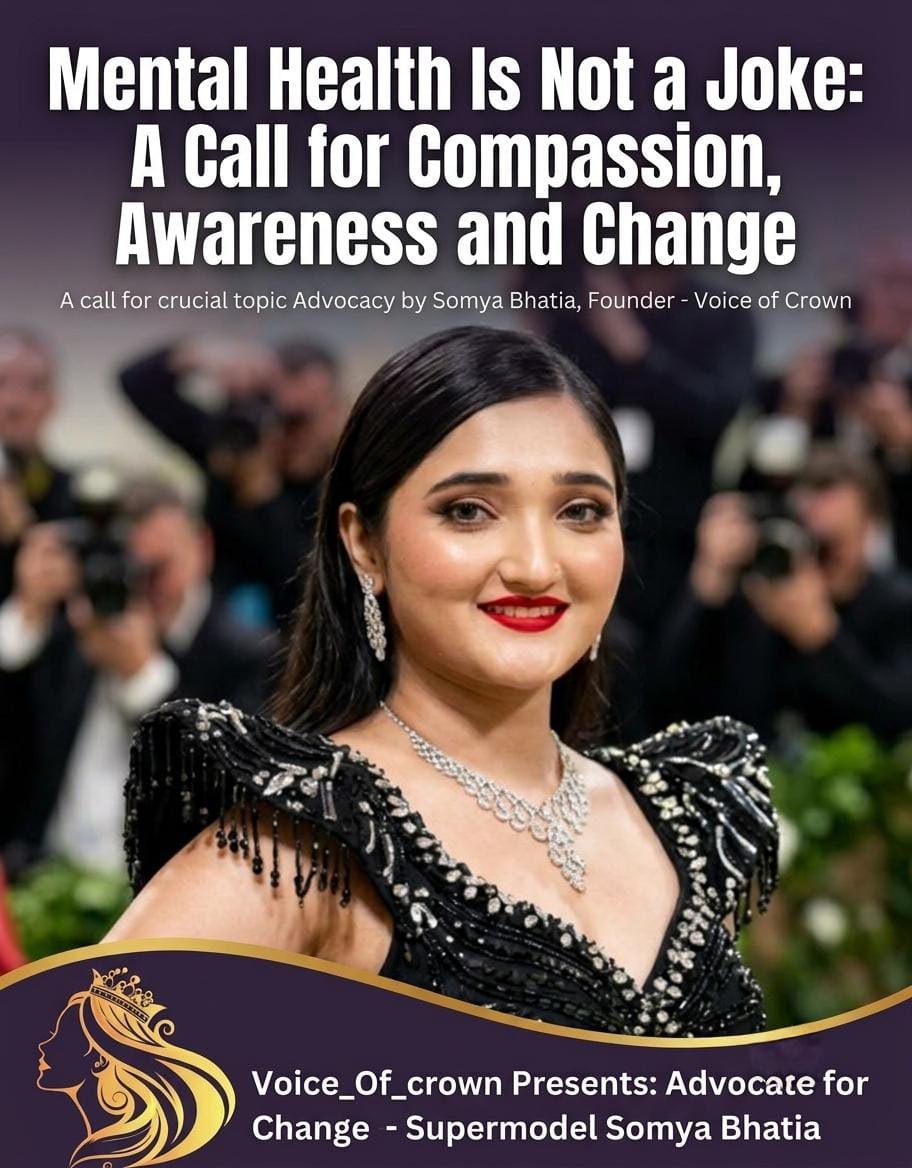
Mental Health Is Not a Joke: A Call for Compassion, Awareness and Change
By Somya Bhatia, Founder — Voice of Crown
As the founder of Voice of Crown, I believe that advocacy is not only about speaking about social issues—it is also about having the courage to address subjects that people often prefer to ignore.
Today, I want to speak about mental health.
I am addressing this issue because I have personally observed, faced and felt how deeply emotional pain can affect a person. There have been experiences in my own life that were not only mentally traumatic but deeply wounding on an emotional level. One of the most difficult parts of going through a painful period can be feeling that nobody truly understands what you are experiencing.
Sometimes, instead of understanding, a person may face harsh words, disrespect, humiliation, rejection, criticism, emotional pressure or behaviour that makes an already difficult situation even harder.
And this is something we need to talk about.
Mental health is not a joke. Emotional pain is not attention-seeking. And a person’s suffering should never become entertainment, gossip or an excuse to hurt them further.
What Can Affect a Person’s Mental Health?
Mental-health difficulties can develop for many different reasons, and there is rarely one explanation that applies to everyone.
A person may experience prolonged stress because of education, career pressure, financial problems, family conflict, relationship difficulties, workplace experiences, bullying, harassment, loneliness, discrimination, grief or major changes in life.
For some people, difficult experiences begin much earlier.
Mental Health Can Be Affected During Childhood Too
A child may not always have the words to explain what they are feeling.
Repeated bullying, humiliation, harsh criticism, neglect, constant comparison, fear, rejection, family conflict or being made to feel worthless can affect a child’s emotional development.
When a child repeatedly hears that they are “not good enough,” is constantly compared with others, is bullied at school, or feels that nobody listens to them, those experiences can leave lasting emotional effects.
Children need more than food, education and physical protection. They also need emotional safety.
Adults should remember that something that may appear “small” to them can feel enormous to a child.
When Nobody Understands You
One of the most painful experiences can be trying to explain what you are going through and feeling that nobody understands.
Instead of asking, “What happened to you?”, people may say, “Why are you behaving like this?”
Instead of listening, they may judge.
Instead of offering support, they may become rude, disrespectful or dismissive.
And sometimes, the person who is already struggling begins to believe that their feelings do not matter.
This is why compassion matters.
We may not understand someone’s entire situation, but we can still choose not to make their pain worse.
What Can We Do to Safeguard Mental Health?
There is no guaranteed way to prevent every mental-health difficulty. However, there are steps that can help protect emotional wellbeing and encourage earlier support.
Create boundaries.
You have the right to distance yourself from people or environments that repeatedly cause emotional harm where it is safe and possible to do so.
Speak to someone trustworthy.
Keeping everything inside can make difficult experiences feel even more isolating. A trusted friend, family member, teacher, counsellor, doctor or mental-health professional may be able to help.
Take persistent distress seriously.
If sadness, anxiety, fear, hopelessness or emotional exhaustion continues or begins affecting everyday life, professional support should be considered.
Protect your digital wellbeing.
Online harassment, bullying and constant comparison can affect emotional wellbeing. Blocking, reporting and documenting serious harassment can be appropriate steps.
Do not be ashamed of professional help.
Seeing a psychologist, psychiatrist, counsellor or doctor is not a sign of weakness. Mental health deserves professional care when professional care is needed.
What Society Needs to Change
We need to stop casually calling people “crazy” when they are struggling.
We need to stop laughing at emotional pain.
We need to stop humiliating people for seeking help.
We need to stop assuming that someone who looks successful cannot be suffering.
And we need to teach children that speaking about their emotions is not something to be ashamed of.
A healthier society begins when we learn to listen before judging.
My Message Through Voice of Crown
Through Voice of Crown, I want to use my voice not simply to highlight problems, but to encourage awareness, dignity, compassion and positive change.
My own experiences have taught me that sometimes a person does not need another person to tell them how they should feel. They need someone willing to listen and understand.
I do not want anyone—especially a young person—to believe that they have to silently tolerate emotional pain just because others do not understand it.
Be careful with your words. Be careful with your behaviour. You never know what someone is already carrying.
And if you are struggling, asking for help does not make you weak.
It makes you human.
Mental health deserves the same seriousness, dignity and care that we give to physical health.
Let us create a culture where people are heard instead of judged, supported instead of humiliated, and encouraged to seek help instead of being ashamed of needing it.
Because sometimes, one compassionate person, one safe conversation or one moment of genuine understanding can make a difference.
Mental health is not a joke.
Mental health is a responsibility.
And protecting it is a responsibility we all share.