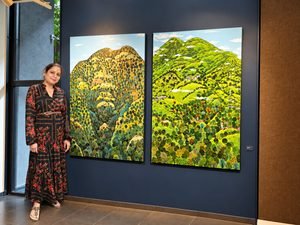
Satyabhama Majhi: Five Earths, One Sacred Triangle — Where Niyamgiri Becomes Colour and Colour Becomes Prayer
Explore Satyabhama Majhi’s artistic journey through Niyamgiri, Dongaria Kondh traditions, natural pigments, indigenous knowledge, ecology and cultural memory.
INDIA | ART • MEMORY • ECOLOGY • INDIGENOUS KNOWLEDGE
Her work explores the Dongaria Kondh community, where art is deeply connected with the land and the deity Niyam Raja. Through natural pigments made from chalk, charcoal, turmeric, geru and brown stone, Satyabhama Majhi transforms the landscape into a medium of memory, identity and artistic expression.
New Delhi / Bhubaneswar | With reference to Satyabhama Majhi’s official website
For the Dongaria Kondh community of Odisha, art is more than something displayed in a gallery. It is part of everyday life, expressed through walls, symbols, rituals and a deep relationship with the land.
Bhubaneswar-based contemporary artist Satyabhama Majhi has spent more than 12 years engaging with the Dongaria Kondh community and the landscape of Niyamgiri. Her artistic research focuses not simply on representing the community, but on understanding how its people express their relationship with land, spirituality and identity through art.
When Art Becomes a Bond With Land
A central part of Majhi’s practice explores the artistic traditions of the Dongaria Kondh community, where visual expression is closely connected with the land and the deity Niyam Raja.
Inspired by the community’s tradition of painting their homes, Majhi studied their wall art and methods of gathering natural pigments. Here, colour is not simply purchased—it is found within the surrounding landscape.
As she writes:
“For the Dongria, Niyamgiri is not a mountain to see, but a deity to live within. The Niyamgiri hills are not just their home, they are their god, their art and their life and Dongria paint that faith on every wall.”
Her engagement therefore becomes an exploration of the connection between art, land, faith and community life.
Five Sacred Earths: Turning Natural Materials Into Art
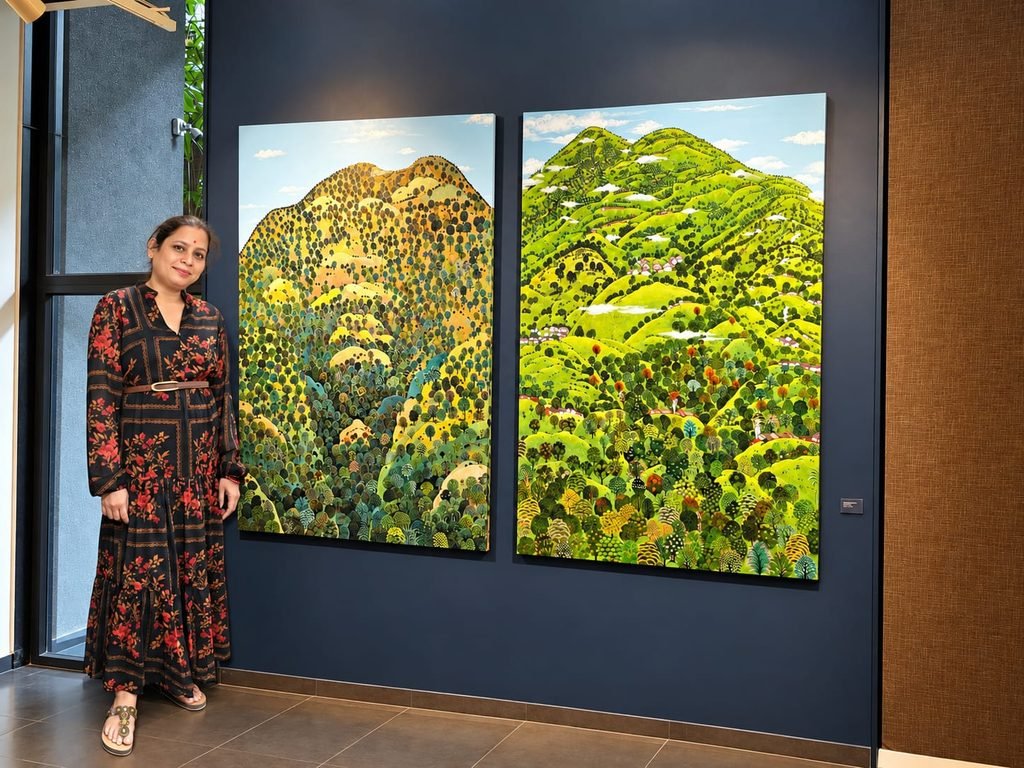
One of the defining features of Majhi’s work is her use of natural materials associated with Niyamgiri. She worked with chalk stone, charcoal, turmeric, geru soil and brown stone, combining them with natural glue to create an earth-rooted medium.
These materials carry meaning beyond their physical qualities. They connect the artwork to the landscape that inspired it and allow natural elements to become carriers of memory.
Majhi describes the process:
“I ground five souls of Niyamgiri into colour and raised them into one sacred triangle — where the land becomes art and art becomes prayer to Niyam Raja.”
She further writes:
“From the five sacred earths of the Niyamgiri, I forged a single triangle not just a form but the soul of the Dongaria Kondh, their mountain, their god, their existence.”
This idea lies at the heart of her practice: soil becomes more than a material—it becomes a connection to memory, identity and place.
The Sacred Triangle and the “Up and Down” Motif
The sacred triangle is an important recurring element in Majhi’s work. Drawn from Dongaria visual culture and the silhouette of the Niyamgiri hills, the triangular form represents ideas of stability, sacred geography and divinity.
Another recurring motif is “Up and Down,” inspired by the everyday journeys of Dongaria women as they travel uphill and downhill for water, markets and rituals. The movement becomes a visual metaphor for struggle, resilience and persistence.
Through these motifs, Majhi connects artistic expression with the community’s lived experiences and worldview.
Un-Urbanisation and the Memory of Changing Cities
Majhi’s artistic concerns also extend beyond Niyamgiri. Her concept of “Un-Urbanisation” focuses on documenting the changing landscapes and memories of old Bhubaneswar and Cuttack.
Her work considers what happens to community life and cultural memory as older neighbourhoods change with rapid urban development. Through public art and community projects, she turns walls and shared spaces into places where memories can remain visible.
Her public art projects have included work associated with Ring Road, Cuttack, the Hockey World Cup in Bhubaneswar, Pago and Thought Loom.
Art, Education and Community Engagement
Satyabhama Majhi holds an M.F.A. in Traditional Art and is the Secretary of the Sasatwa Foundation. In 2023, she was a Co-Sutradhar of People’s Wall – Jan, Janani, Janmabhumi for the New Parliament House in New Delhi, a project commissioned by the Lalit Kala Akademi.
For around 15 years, she has also worked as an art educator with children in tribal schools, underserved communities and children with disabilities. Her educational work has included associations with Gram Vikas, Tata Trusts and Kalpanadham.
Her approach to teaching can be summed up in one simple line:
“Don’t copy, remember.”
The idea reflects her broader belief in observation, memory and personal expression rather than simply reproducing existing forms.
Recognition and Artistic Journey
Majhi has received the Odisha Lalit Kala Akademi State Award in 2012 and the National Lalit Kala Akademi Scholarship for 2009–10.
Her exhibitions and projects have included Bharat Bhavan, Bhopal; Nature Morte, Gurgaon; Lalit Kala Akademi, New Delhi; Odisha Lalit Kala Akademi; Bhubaneswar Art Trail; Gram Art Project and Vancouver Biennale-linked projects.
Her practice continues to move between galleries, public spaces, communities and landscapes, with recurring themes of memory, ecology, cultural identity and place.
Land as Memory, Matter as Landscape
Majhi’s work was recently part of the group exhibition Land as Memory, Matter as Landscape at artCENTRIX Space, New Delhi.
The exhibition brought together different aspects of her practice. One body of work explored the changing urban landscapes of Bhubaneswar and Cuttack, while another returned to the natural and cultural landscape of Niyamgiri.
The two perspectives are connected by a common idea: land can hold memory, while materials from that land can become a way of preserving identity.
Keeping Places and Memories Alive
Satyabhama Majhi’s work brings together art, ecology, indigenous knowledge, spirituality and cultural memory. Her engagement with the Dongaria Kondh community explores how natural materials and traditional symbols can communicate a relationship with the land, while her work on urban memory considers what may disappear as cities change.
At the centre of her practice is a question that extends beyond art:
How do we keep our places, cultures and memories alive as the world around us changes?