Tecniz Clocks: Reviving the Art of Handcrafted Timepieces from Kerala
Tecniz Clocks: Reviving the Art of Handcrafted Timepieces from Kerala
In a world where most clocks are manufactured by the thousands, there is something quietly remarkable about a clock made one piece at a time.
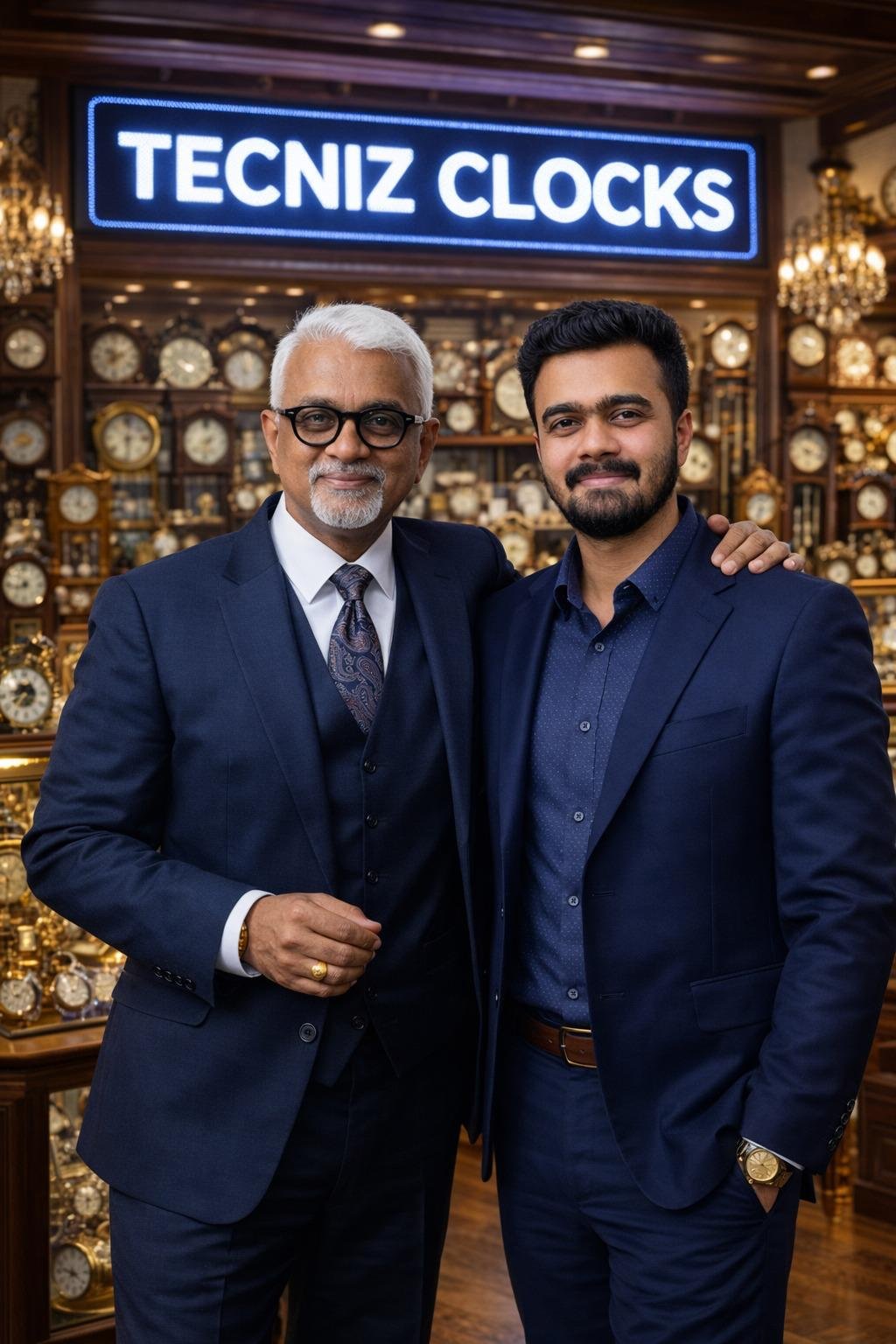
From Kerala, Tecniz Clocks is bringing that idea back into focus. The handcrafted wooden clock brand represents a new chapter in a story that began nearly four decades ago, when horology graduate Satheesh Kumar founded Tecniz in 1986. After operating the business for four years, he moved to the Middle East for professional opportunities. Decades later, his son Athul Satheesh returned to the family name and revived Tecniz in 2025 with a different vision — to design and create original wooden clocks rather than simply repair or service existing ones.
The result is a young clockmaking brand with an unusually old soul.
From a Horology Degree to a New Generation of Clockmaking
The revival of Tecniz is more than the reopening of a family business. Athul has taken the foundation created by his father and reimagined it for contemporary customers.
The brand focuses on handcrafted wooden clock cases, predominantly created from Indian teak and paired with imported quartz movements sourced from Taiwan. Rather than maintaining a large inventory of finished products, Tecniz follows a made-to-order approach. A clock begins its journey after a customer places an order, allowing the design and construction process to remain deliberate and personal.
Depending on the complexity of the piece, production and delivery generally take between two and four weeks.
This slower approach may seem unusual in an age of instant purchases and mass manufacturing. Yet it is precisely what gives handcrafted products their character. Each clock passes through a process of design, woodworking, finishing and assembly instead of simply being selected from a warehouse shelf.
When Kerala Teak Becomes Part of the Design
For Tecniz, the material is almost as important as the mechanism.
Indian teak has a particularly strong connection with Kerala, where the timber has played an important role in architecture, furniture and traditional woodworking. Nilambur, in northern Kerala, is especially associated with teak cultivation and is home to Connolly’s Plot, widely regarded as one of the world’s oldest teak plantations.
Teak’s durability, distinctive grain and resistance to moisture have made it a valued material for generations. These qualities also make it well suited to clock cases, where the wooden exterior is not merely functional but forms much of the personality of the finished timepiece.
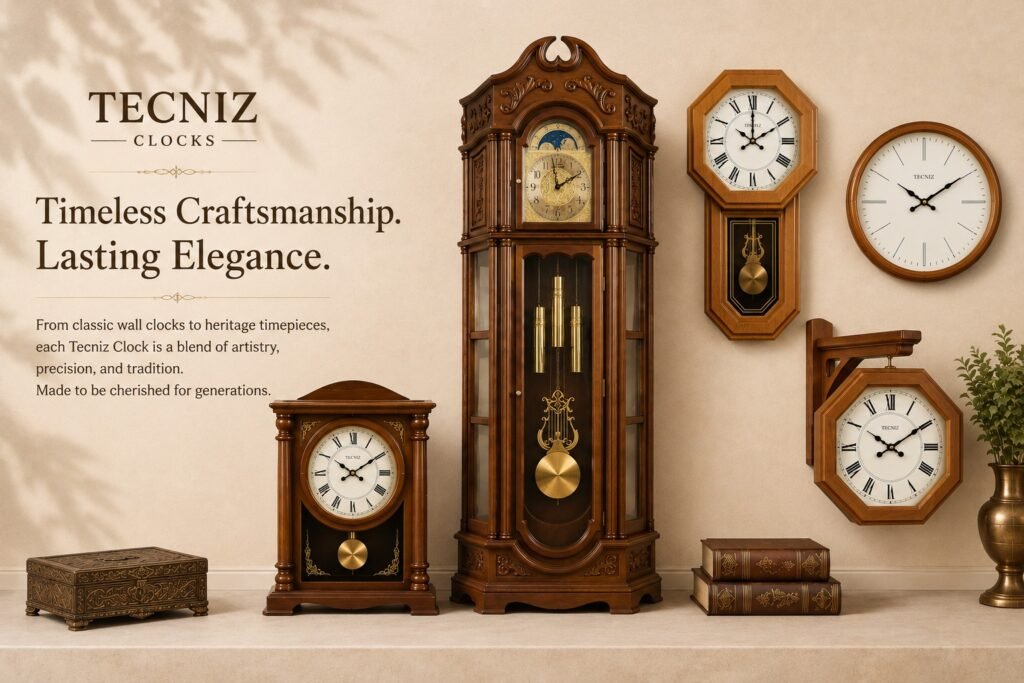
Tecniz uses this natural character to create cases ranging from traditional pendulum designs to geometric contemporary forms. The grain of the wood becomes part of the visual identity of each clock, ensuring that even pieces based on the same design can retain subtle differences.
A Collection Built Around Different Expressions of Time
Tecniz’s collection moves between classical clockmaking forms and more contemporary interpretations.
Its range includes the Circle Series, featuring round wall clocks; the Quadrant Series of square and rectangular designs; the Octa Heritage and Deca Signature collections; and the Royal Pendulum series inspired by traditional pendulum clocks.
The brand also explores clocks designed for desks and tables through its Desktime Collection, while its Floor Clock Series brings the presence of grandfather-style clocks into the collection.
For customers looking for something less conventional, the Designer Clocks range introduces distinctive forms, including an anchor-inspired clock. The Divine Edition, meanwhile, draws from Indian cultural themes, including the Kurukshetra Chakra Clock.
Together, these collections show how a familiar household object can be interpreted through different architectural shapes, cultural references and woodworking styles.
Craftsmanship Over Mass Production
Perhaps the most distinctive aspect of Tecniz is its decision to keep the making process relatively personal.
A mass-produced clock is primarily an object of utility. A handcrafted clock can become something else — part of a home’s character, a decorative centrepiece, a conversation starter or even an heirloom intended to remain in a family for years.
That difference is central to the philosophy behind made-to-order production.
The use of wooden cases also means that Tecniz clocks occupy a space between horology and traditional craftsmanship. The movement provides the function, but the wood provides much of the emotional and visual identity.
Every piece therefore carries two stories: the story of time measured by the mechanism and the story of material shaped by the maker.
A Family Legacy Reimagined
The most compelling part of the Tecniz story may ultimately be the generational connection behind it.
In 1986, Satheesh Kumar entered the clockmaking world after studying horology. Nearly 40 years later, his son Athul Satheesh revived the name and gave it a new direction.
The first chapter was built around horological knowledge and a physical clock shop. The new chapter is built around design, handcrafted production, Indian teak and a digital-age customer base.
That transition reflects a broader shift taking place across traditional crafts. Heritage does not necessarily have to mean reproducing the past exactly as it was. Sometimes, preserving a legacy means giving the original idea a new form.
A Small Chapter in a Much Larger Story
Tecniz is still a young brand in its present form, and its contemporary journey has only recently begun. It does not yet have the century-old archives or international recognition associated with historic European clockmakers.
What it does have is arguably more interesting at this stage: an origin story, a family connection to horology, a regional material tradition and a willingness to make something by hand in an industry dominated by mass production.
From Kerala, Tecniz is attempting to build a modern Indian identity around an object that has been part of human civilization for centuries.
A clock measures seconds, minutes and hours. But a handcrafted clock can also preserve something less measurable — craftsmanship, memory, place and heritage.
And perhaps that is what makes the revival of Tecniz worth watching. It is not simply about making clocks.
It is about giving time a physical form again.
Website : https://www.tecnizclocks.com/