Building an AI Operating System to Connect the Entire Business Journey
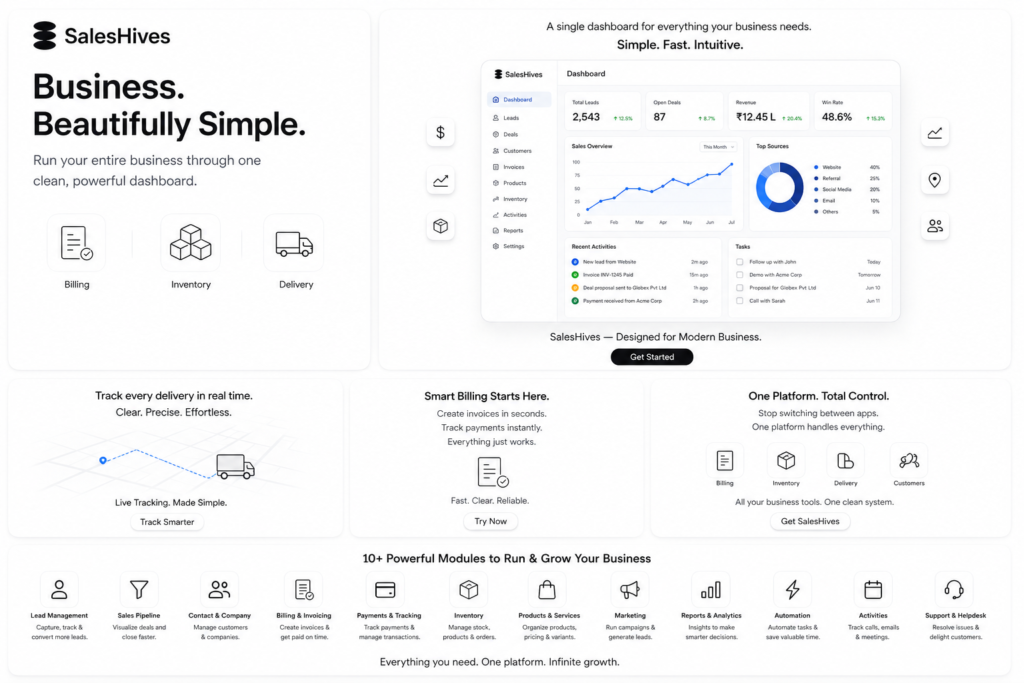
Building an AI Operating System to Connect the Entire Business Journey
From lead generation and customer management to billing, inventory, delivery and AI-powered operations, SalesHives aims to help growing businesses replace fragmented software with one connected platform.
The software problem businesses created while trying to become more efficient
As a company grows, its software stack often becomes more complicated than its actual business. A lead may arrive through one application, customer records may live in a separate CRM, quotations and invoices may be created elsewhere, inventory may be maintained in spreadsheets, and delivery updates may still depend on phone calls or manual messages.
Each tool can work well on its own. The difficulty begins when information must move from one department to the next. Sales teams may not know whether an invoice has been paid. Finance teams may not have the latest customer context. Inventory records may not reflect active orders. Delivery teams may lack the information needed to update customers quickly.
SalesHives is being developed around a simple proposition: a growing business should not need a collection of disconnected applications to manage one customer journey. The platform describes itself as an AI business operating system that connects customer acquisition, revenue operations, products, fulfilment, communication, reporting and artificial intelligence within one operating workspace.
One customer journey, connected from beginning to end
The clearest way to understand SalesHives is to follow a customer through the platform.
A prospective buyer first enters as a lead. The business can record the enquiry, manage contact information, assign follow-up activity and move the opportunity through its sales process. When the customer is ready to proceed, the same relationship can continue into quotations, invoices and payment records rather than being recreated in another application.
For a product-led business, the transaction can then connect with products, inventory, purchasing, suppliers, orders and delivery. Once fulfilment begins, internal teams can coordinate the order while customer communication is supported through reminders, email and WhatsApp-oriented workflows where enabled.
After the transaction, reports and analytics can use information from across the journey. The AI Command Center can then identify risks, opportunities or actions based on the records already available in the workspace.
Why SalesHives is broader than a CRM
SalesHives includes CRM and lead-management capabilities, but the product is designed to continue working after a deal is closed.
Its current module structure covers leads, customers, CRM, sales, billing, invoices, payments and subscriptions. Operational modules cover products, inventory, purchasing, suppliers, orders and delivery. The platform also includes expenses, tax-oriented workflows, reports, analytics, digital catalogues, website-building capabilities, integrations, employees, roles and configurable workspace controls.
That distinction matters. A CRM normally helps a business manage relationships and opportunities. SalesHives is intended to connect those relationships with the work required to collect revenue and fulfil the promise made to the customer.
The platform may therefore be relevant to businesses that have outgrown spreadsheets and isolated tools but do not want to begin with a complex enterprise system.
Connecting sales with billing and collections
Closing a deal does not automatically create cash flow. For many growing companies, the gap between making a sale and receiving payment becomes a major operational weakness.
SalesHives connects the sales process with quotations, billing, invoices, payment records and collection visibility. Instead of treating the financial stage as a separate workflow, the transaction can continue within the same business context.
The platform’s AI-supported workflows are also designed to identify overdue invoices, prepare reminders, prioritise collection activity and create follow-up tasks. These features are intended to support employees rather than remove financial controls.
Businesses can choose how much authority an AI agent receives. Sensitive or money-impacting actions can be drafted for approval, while lower-risk internal work can be automated according to configured limits and policies.
Products, inventory, purchasing and fulfilment
For retailers, wholesalers, distributors and other product-based businesses, customer management is only one part of the operation. Every sale can affect stock. Low stock can create a purchasing requirement. Purchasing depends on suppliers. Orders must then be packed, dispatched and delivered.
SalesHives includes connected modules for products, inventory, purchases, suppliers, orders and delivery. The objective is to make the operational consequences of a sale visible instead of leaving each department to interpret separate records.
AI-supported workflows can help flag low stock, potential stockouts, slow-moving products, reorder needs and delayed orders. A supplier delay can therefore become an inventory alert, an order-risk signal and a customer communication task rather than remaining hidden in one team’s spreadsheet.
This shared context is central to the platform’s positioning. The value is not only that the modules exist, but that activity in one module can inform the next stage of the business.
Customer communication with real business context
Customer communication is more useful when it is connected to actual records. A generic messaging tool may know that a customer sent a message, but it may not know whether the customer has an unpaid invoice, a delayed order, an upcoming booking or a recent purchase.
SalesHives is designed to connect customer communication with CRM, invoice, order, delivery and other operational information. Depending on configuration and regional availability, businesses may use email communication, reminders, WhatsApp-oriented workflows, customer updates and segmented campaigns.
This allows a payment reminder to refer to a real invoice, a delivery update to relate to an actual order, and a reactivation campaign to focus on customers whose purchase history supports the message.
Businesses remain responsible for consent, approved templates, provider policies and applicable communication laws.
An AI Command Center designed for controlled action
One of the more ambitious areas of SalesHives is its AI Command Center. Rather than limiting artificial intelligence to copywriting or a chatbot, the system is designed to analyse business records and generate operational recommendations.
AI agents can help score leads, identify stale opportunities, create follow-up tasks, draft customer messages, monitor overdue invoices, detect inventory risk, prepare purchase suggestions, flag delayed orders, generate owner reports and identify customer-reactivation opportunities.
The product supports multiple operating modes. At the most controlled level, AI only analyses and suggests. In approval mode, it prepares drafts and approval cards. Low-risk modes can complete selected internal tasks automatically. More advanced configurations can execute predefined actions within limits involving risk, amount, frequency or audience size.
High-risk, sensitive, financial, legal, tax or policy-sensitive actions can remain blocked or require explicit approval. The aim is to create useful automation without treating every AI recommendation as automatically executable.
Who may find the platform relevant
SalesHives may be relevant to retailers, wholesalers, distributors, agencies, consultants, service companies, ecommerce sellers, appointment-led businesses, local delivery teams and organisations with multiple employees or departments.
Its strongest fit is likely to be a business that wants several operating functions connected, needs shared reporting and permissions, and is trying to reduce its reliance on spreadsheets or manually synchronised applications.
SalesHives is positioned as a global product rather than an India-only billing application. Regional tax systems, payment options, integrations, communication capabilities and plan availability may vary, so businesses should verify current requirements before purchasing.
The larger opportunity
The next phase of business software may not be defined by giving companies more standalone tools. It may be defined by helping them operate with fewer disconnected systems.
SalesHives is entering a competitive market that already includes CRM platforms, invoicing products, inventory applications, messaging tools and business-management suites. Its opportunity lies in connecting functions that many growing businesses still manage separately.
The platform’s success will ultimately depend on execution: reliability, usability, integrations, security, regional support and the practical value created by its AI agents. But the underlying proposition is clear.
A lead should remain connected to the resulting customer. The customer should remain connected to quotations, invoices and payments. Orders should remain connected to inventory and delivery.
Communication should have access to the relevant business context. Analytics and AI should reflect the complete operation rather than one isolated department.
SalesHives is building one system around that complete journey – helping businesses sell, bill, deliver and grow.
| ABOUT SALESHIVES SalesHives is an AI business operating system for growing businesses. It connects customer acquisition, CRM, quotes, billing, invoices, payments, products, inventory, purchasing, orders, delivery, customer communication, websites, reporting, analytics and configurable AI agents in one operating workspace. | Sell. Bill.Deliver. Grow.saleshives.com |
Official website: www.saleshives.com | Support: support@saleshives.com